




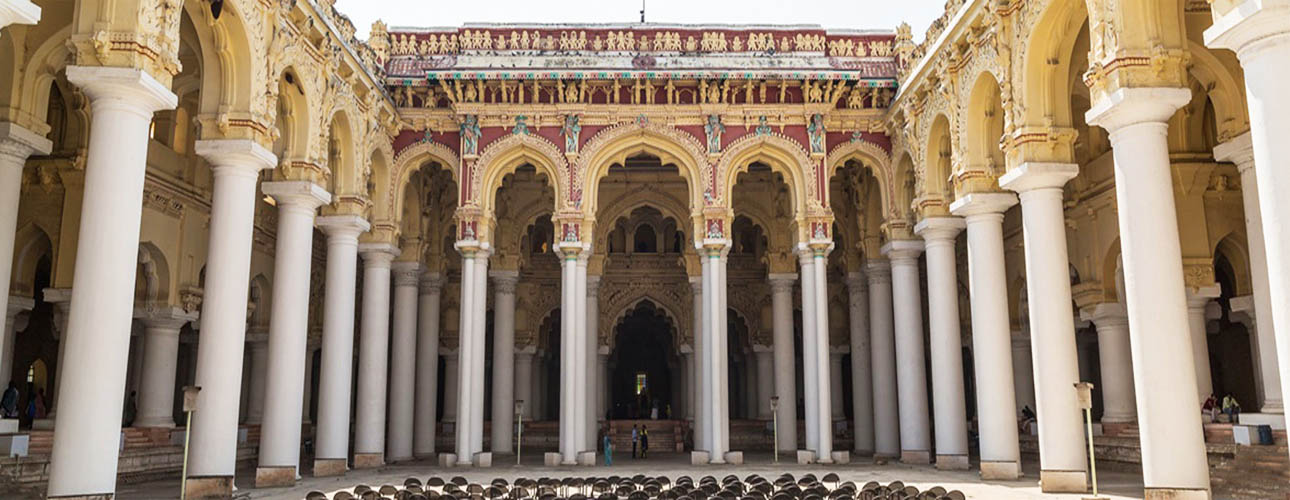
One of the most iconic landmarks that comes to mind when we think of Madurai is the majestic Thirumalai Nayakkar Mahal. Built in the 17th century by King Thirumalai Nayakkar of the Nayak dynasty, this architectural marvel stands as a living testimony to the rich history of Madurai and the brilliance of Nayak-era architecture.
Location & Style
Located about 2 km southeast of the Meenakshi Amman Temple, the Mahal is a classic example of Indo-Saracenic architecture—a fusion of Islamic and Dravidian styles. The structure captivates visitors with its intricate carvings, grand pillars, and spacious design.
Majestic Pillars
The defining feature of the Mahal is its 248 colossal pillars, each approximately 82 feet tall and 12 feet wide. Adorned with detailed stonework, these pillars highlight the precision and creativity of 17th-century artisans. The central courtyard, once the venue for royal assemblies, adds to the palace’s splendor. Its dome (Shikhara) atop the hall is a marvel in itself.
Construction Materials
Interestingly, no wood was used in the construction. Instead, a unique mixture of brick, lime mortar, jaggery, tamarind seeds, myrobalan (kadukkai), and gooseberry (nellikai) was applied throughout the structure, enhancing both its durability and elegance.
Acoustics & Light Design
The palace was designed with advanced engineering techniques of its time—capable of reflecting and amplifying both sound and light. The acoustics are so refined that the king’s voice could be clearly heard throughout the assembly hall. It is a true example of architectural intelligence.
Key Sections of the Mahal
- Swarga Vilasam – The throne room of the king, featuring a grand dome and exquisite ornamentation.
- Nartanasala – A hall dedicated to dance and cultural performances.
- Palakurasi – The king’s private resting area.
Though several parts of the Mahal were damaged over time, the most important sections have been preserved remarkably well.
Historical Significance
Construction began in 1636 AD under King Thirumalai Nayakkar. Initially used as both royal residence and court, the Mahal fell into disrepair after the decline of the Nayak dynasty. In the 19th century, parts of the palace were restored under British rule, and today it is maintained as a national monument.
Tourist Attraction
Today, Thirumalai Nayakkar Mahal is one of Madurai’s top tourist destinations. The Sound and Light Show held every evening vividly narrates the history of the Nayak kings and the legacy of the palace. It offers an immersive experience not only for students and history enthusiasts but also for international travelers keen to explore South Indian heritage.
Conclusion
A visit to Madurai is incomplete without witnessing the grandeur of Thirumalai Nayakkar Mahal. It is more than just a building—it is a living symbol of timeless art, history, and culture.